Mentions
A national survey where some participants are Black, but results are never reported by race.
41%
KIN Relevance
Not every study that mentions Black people is meaningfully about Black life.
Mentions
A national survey where some participants are Black, but results are never reported by race.
Meaningfully about
A study designed around Black mothers, analyzing outcomes and experiences specific to them.
Illustrative examples.
What it is
A study can include Black participants without actually telling us anything meaningful about Black outcomes.
KIN Relevance is designed to look beyond simple keyword matches and help identify research where Black populations are meaningfully connected to the study population, analysis, findings, and question.
It looks at each study across six dimensions.
Are Black populations central to the study?
Does the study actually address the question being asked?
Are Black-specific outcomes meaningfully analyzed?
Does the research produce findings that directly inform the question?
Do geography, age, gender, setting, or timeframe affect applicability?
Is the research record complete enough to support useful interpretation?
Match Score
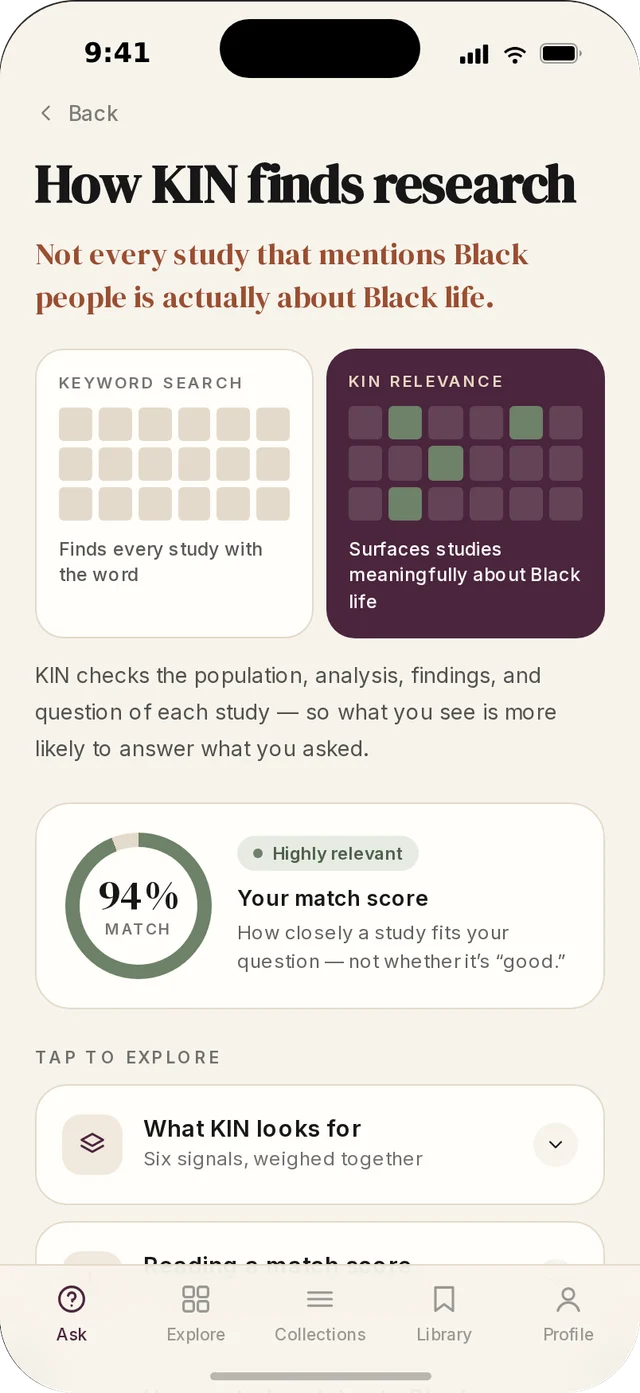
Screens from the KIN prototype. Studies shown are demo data.
Very strong match
Black populations are central, and the study directly addresses the question.
Strong match
Closely connected, with some limits on population, context, or focus.
Moderate match
Useful context, but only partly answers the question for this population.
Limited match
Mentions the population or topic without meaningfully informing the question.
Very strong match
A multi-city study of Black mothers, with outcomes analyzed specifically for them.
Strong match
Race-stratified findings on the topic, drawn from a single state’s data.
Limited match
A national sample that includes Black participants but does not report results by race.
Illustrative examples. Bands are indicative and may be refined.
Two different questions
Relevance asks: does this study speak to my question?
Evidence strength asks: how much weight can its findings bear?
KIN shows both, separately, so a well-matched study is never mistaken for a definitive one.
Strong study, different question
Rigorous, but not meaningfully about this population or question.
Core evidence
Highly relevant and methodologically strong. Carries the most weight.
Background at most
Limited relevance and limited evidence.
Promising — interpret with care
Closely matched to the question, but the evidence is emerging or limited.
Why This Matched
Demo study: Delivery-hospital quality and severe maternal outcomes among Black patients
Why this matched
Transparency & limitations
Early access
We are building KIN with researchers, students, educators, community leaders, and early users who believe credible research should be easier to access and understand.